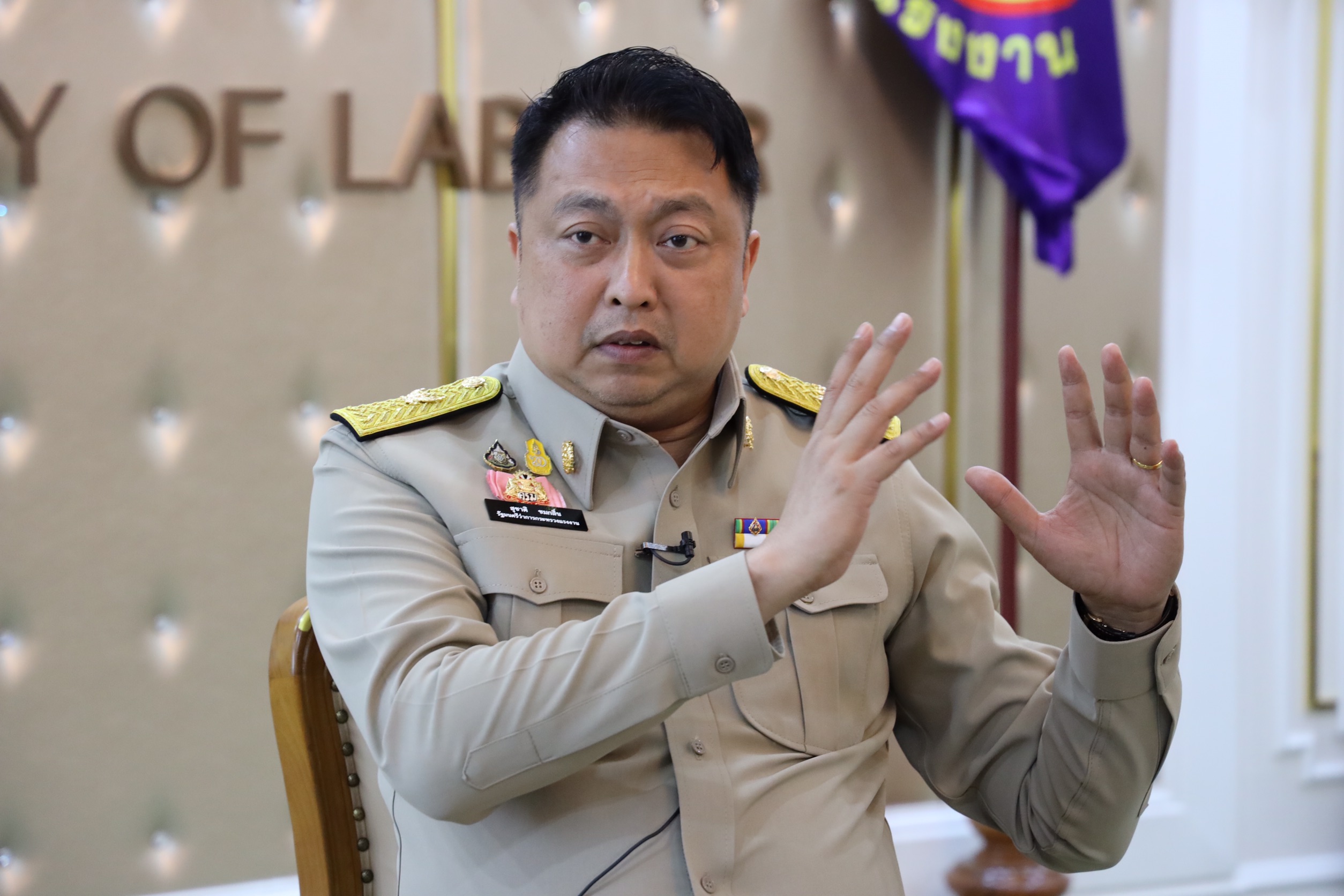

The Labour Minister ordered the Department of Employment to work proactively in collecting job vacancies to accommodate nearly 100,000 unemployed people, accelerating the push forward to resolve unemployment problems in all sectors due to the toxic effects of Covid-19.
Labour Minister Mr. Suchart Chomklin emphasized the issue of unemployment, which has occurred in all sectors of the nation, accelerating the creation of jobs in all dimensions to alleviate suffering immediately. He said that the impact of the Covid-19 pandemic has resulted in unemployment globally. There are now 91,444 job vacancies to support the unemployed. In raising the rate of economic recovery after the Covid-19 impacts, the government, led by Prime Minister and Defense Minister General Prayut Chan-ocha, places importance on unemployment throughout the nation. Immediately upon assignment by the Prime Minister, the Ministry of Labour has established a solution to the problem of unemployment and has sought to stimulate urgent employment. Now, the Department of Employment has prepared job vacancies to accommodate the unemployed with 91,444 positions, which are divided as follows:
1) Opening international markets in collaboration with the Thai Labour Exporters Association. Thai workers are currently in high demand from many foreign job markets as the Thai government has maintained effective management of Covid-19, eliminating infections for a long time now. This makes it an excellent opportunity to expand the labour market. Currently, workers are sent to low-risk countries such as Taiwan, which has intensive measures to prevent infection. The Department of Employment has found that there are still job positions available for deploying Thai workers abroad after the Covid-19 situation, with 49,077 vacancies in Taiwan, Japan, South Korea, Malaysia, Singapore, and Israel. The Ministry of Labour will coordinate closely with many other countries to send Thai people to work in new professions, immediately after the Covid-19 situation begins to improve.
2) Domestic jobs across the country, both in the private sector from the Smart Job system, which has both regular and part-time employment, include vacancies in the Eastern Special Development Area (EEC) in 3 provinces: Rayong, Chonburi, Chachoengsao. This is an area in driving labour, the economy, and society. There are 42,367 vacancies (data from the Division of Employment Service System Development, Department of Employment). The positions cover all levels of education from primary school up to a bachelor’s degree.
Based on data from the Department of Employment, the top 10 most demanded job vacancies nationwide are: 1. Manufacturing workers 2. Workers in various production areas and general labourers 3. Jewelers and other jewelry craftsmen 4. Brokerage agents selling other business services 5. Sales staff (in the shop), shopfront sales staff 6. Other delivery staff 7. Sales staff and other product presenters 8. Drivers 9. Other warehouse workers 10. Security staff and security guards. Most part-time positions require: 1. Production workers 2. Other delivery staff 3. Accountants and cashiers 4. Other transportation personnel 5. Sales staff and other product presenters 6. Workers in various production areas and general labourers 7. Auction sales staff 8. Loan and finance offices 9. Brokerage agents selling other businesses 10. Sales staff (in the shop), shopfront sales staff. Vacancies in the Eastern Economic Corridor (EEC) in the three provinces, namely Rayong, Chonburi, and Chachoengsao, are essential areas for driving labour, the economy, and society job categories with the highest labour demand are 1. Workers in various production areas and general labourers 2. Security guards 3. Other service workers 4. Jewelers and other jewelry craftsmen 5. Product quality inspectors 6. Electrical engineering technicians 7. Civil engineering technicians (construction) 8. Sales staff and other product presenters 9. Chemical technicians (organic chemistry, rubber, plastics, polymers, paint, paper, oil, fiber, food, and beverage) 10. Marketing staff and others (other mechanical engineering technicians, house cleaners, and other related workers, electroplating welders, etc.). The Labour Minister also directed all units in the area to find more new jobs by working proactively with the establishment in sourcing job vacancies and matching jobs for the unemployed. This includes professional skills training to support allowances with the National Labor Administration Center as a central command center, said Mr. Suchart.
Meanwhile, it has also put in place guidelines to use a platform called “Thailand has work; a collaboration between the NESDB and the Bank of Thailand, “specifically to address the unemployment problem. It brings together more than 400,000 public and private jobs and loan programs to serve the people. It allows for applications to online and classroom training as a comprehensive platform for promoting employment. The platform is currently under development and is expected to serve people by the end of this month. In addition, the government, by the Ministry of Labour and various ministries, has mobilized projects to employ to generate nearly 100,000 vacancies, for income to support the unemployment problem. Other ministries include the Ministry of Higher Education. Science, Research and Innovation, the Ministry of Interior, the Ministry of Natural Resources and Environment, and the Ministry of Agriculture, for example. The Ministry of Labour in the 2021 fiscal year has requested to allocate budget to undertake employment projects for the people in the amount of 30,000 vacancies as well.
Mr. Suchart Chomklin concluded that the impact of Covid-19 had caused the labour market in Thailand to fluctuate. This is a situation that has occurred around the world. The government realizes that if the country’s workers have no employment, it will inevitably affect domestic spending, which has chain effects on other sectors. The government will accelerate planning and take measures to cover and achieve the best results for all labour groups to get back into the employment system as much as possible and drive the country’s economy better. Thailand ranks top in the world in tackling Covic-19 well, to the extent that almost 100 percent of businesses in the country have returned to normal capacity.